
What Is Block Blast?
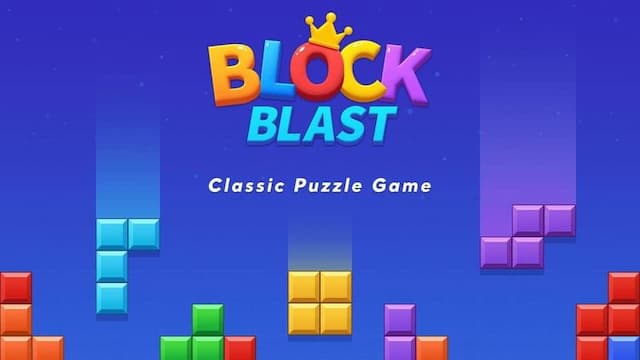
Block Blast is a free browser-based puzzle game that combines strategic block placement with combo-driven scoring on a fixed 8×8 grid. Players drag geometric shapes onto the playing field, clearing complete horizontal rows and vertical columns to score points. Unlike traditional falling-block puzzles, Block Blast has no time pressure and no rotation mechanics. The focus is on spatial reasoning and planning.
The game uses a three-block selection system where players choose from randomly generated pieces, creating a gameplay loop that beginners can pick up quickly but takes time to master.
How to Play Block Blast: 6-Step Guide
- Analyze your three blocks. Study the available shapes (I-pieces, L-shapes, T-pieces, squares, Z-pieces) and their best grid positions before placing.
- Place corners first. Put awkward or large shapes in corner areas early, when you have the most grid space available.
- Fill complete lines. Target filling all 8 squares in a row or column to trigger a clear.
- Chain combos. Clear multiple lines in a single move for bonus multipliers on your score.
- Keep the center open. Leave middle grid areas empty to preserve placement options for future pieces.
- Track your density. Watch how much grid space is left. The game ends when none of your three blocks can fit.
The game ends when none of your three available blocks can fit in the remaining grid space.
Core Game Elements
Grid. Fixed 8×8 playing field with 64 placement squares. Unlike Tetris, which uses a 10×20 vertical orientation, Block Blast uses a square format built for drag-and-drop mechanics.
Block shapes. Seven primary geometric forms: single-square dots, 2-5 square linear pieces, L-configurations, T-shapes, square blocks, and Z/S-shaped pieces. Each piece keeps its orientation. You cannot rotate pieces.
Scoring. Base points are awarded per cleared line. Combo multipliers apply when multiple lines clear at once. Double-clears (row and column together) give the highest point acceleration.
Placement. Blocks stay where you drop them. They do not fall, shift, or disappear unless they complete a line. This lets you plan each move with precision.
8 Pro Tips for Higher Scores
- Corner-first protocol. Place irregular shapes (L-pieces, Z-pieces) in corner positions during early game when you have the most room.
- Three-move lookahead. Before you place a block, check how it affects your next two pieces. Avoid moves that lock you into bad positions.
- Hunt for double-clears. Look for placements that complete both a row and a column at the same time. These give the most points per move.
- Keep center squares open. The middle of the grid gives you the most placement options. Avoid filling these areas early.
- Mental rotation. Even though blocks cannot rotate in-game, visualizing different orientations helps you spot better placements.
- Build combo chains. Instead of clearing lines one at a time, set up multiple near-complete lines and clear them together for a large bonus.
- Breathing room. Keep at least one empty row or column as an emergency zone when the grid gets crowded.
- Count remaining spots. Before placing a block, check whether the next tray piece will still have a valid spot. If not, rethink your placement.
Block Blast vs. Tetris
| Feature | Block Blast | Tetris |
|---|---|---|
| Playing field | 8×8 static grid (64 squares) | 10×20 falling zone (200 squares) |
| Block movement | Drag-and-drop static placement | Gravity-based falling pieces |
| Time pressure | None | Pieces fall faster each level |
| Piece selection | Choose from 3 available blocks | Single piece sequence |
| Rotation | No rotation, fixed orientation | 4-position rotation |
| Clearing | Horizontal rows and vertical columns | Horizontal rows only |
| Game over | No valid placement for any of 3 blocks | Piece stack reaches the top |
| Strategy focus | Spatial planning and combo setup | Reflexes and rotation speed |
| Scoring | Base points plus combo multipliers | Line clear points plus level bonuses |
In Tetris, the pressure is speed. Pieces fall faster each level, and you have seconds to decide. Mistakes pile up until the board overflows.
In Block Blast, time is not the problem. The grid is smaller at 8×8, and you see all three tray pieces before you commit. The challenge is space management. Every block you place shrinks the board, and you cannot rotate or skip pieces. A bad placement does not end the game right away, but it leaves gaps that make future moves harder until nothing fits.
Players who like thinking ahead and managing space tend to prefer Block Blast. Players who want reflex-driven action tend to prefer Tetris.
Block Blast Solver
When the board is tight and the tray pieces look impossible, the Block Blast Solver can help. It reads your current grid, checks every possible placement for each piece in the tray, and shows the move that keeps the most options open.
The solver is free and works with the same 8×8 grid you see in the game. It is a practice tool, not a cheat. Use it when you are stuck, compare its suggestions to your own instincts, and over time you will start seeing better moves on your own.
Block Blast Alternatives
Players who enjoy Block Blast often like these similar puzzle games:
- 1010!, Grid-filling mechanics with different block shapes
- Woodoku, Combines block placement with Sudoku number constraints
- Blockudoku, Merges block puzzles with Sudoku grid rules
- Classic Tetris, The falling block game that started the genre
- Jewels Blitz 4, Match-three gameplay with block clearing elements
Getting Started
The game loads instantly above. No registration, downloads, or payment required. Start with small, careful placements to learn the mechanics, then work toward combo strategies.
Most players reach consistent combo clearing within 20 to 25 sessions. Advanced grid management develops after 50 or more sessions of focused practice. Every Block Blast expert started with the same question: where do I put this L-shaped piece? The answer comes with practice.
For strategy analysis and optimal placement suggestions, try the Block Blast Solver linked above.